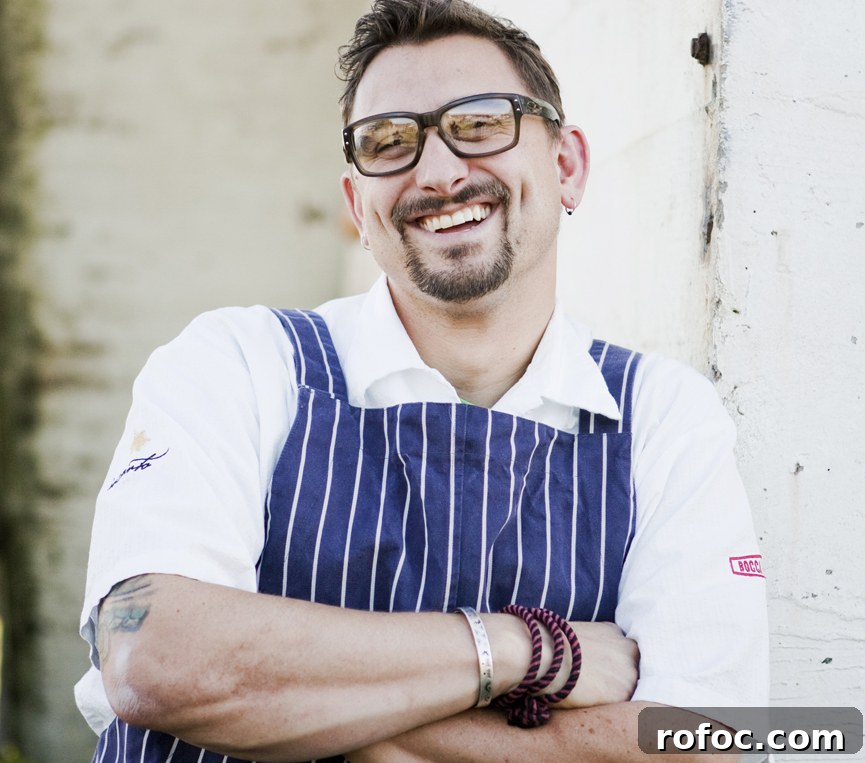
Offal’s Leading Advocate
At the forefront of the whole-animal movement, chef Chris Cosentino entices diners with traditional techniques and thoughtful pairings, transforming organs and extremities into refined dishes at San Francisco’s acclaimed Incanto. In this interview, Chris discusses his passion for offal, his experience on Top Chef Masters, and his recommendations for dining in the city.
AndrewZimmern.com: You’ve become the king of offal. What spurred your interest in nose-to-tail cooking?
Chris Cosentino: I prefer to think of myself as an offal enthusiast rather than a king. My interest grew from several experiences, beginning with the harvest of my first animal — a moment that opened my eyes to how much was routinely discarded. At the same time I was reading older cookbooks filled with offal recipes and became fascinated by the challenge: taking parts that many find unappealing or tough and transforming them into delicate, flavorful bites. I dove into the literature, collected every relevant book I could find, and learned the techniques thoroughly. Over time it became a mission to revive these traditions and demonstrate that these cuts can be desirable again.
AZ.com: How has your Italian-American upbringing influenced your food philosophy?
CC: My roots in an Italian-American community taught me to admire peasant cooking — the ability to create deeply satisfying meals from simple, humble ingredients. Italian peasant food is steeped in family and shared traditions; even when two households make the same dish, they often prepare it in distinctly different ways. The regional depth of flavor and the focus on making the most of every ingredient are central to how I think about cooking and resourcefulness in the kitchen.
AZ.com: What is your convincing argument for someone squeamish about whole-animal cuisine?
CC: Respect for food should be the starting point. When an animal’s life contributes to a meal, that effort and sacrifice deserve consideration. I encourage people to be willing to try something before dismissing it out of hand. At home we have a rule: take a “no thank you bite” before deciding you don’t like a dish. I think that small gesture of curiosity is useful for all diners — it often leads to surprising discoveries.
AZ.com: What needs to change in our food culture for the broader population to accept (and enjoy) eating brains, lungs or feet?
CC: A lot of change comes down to perception and education. In many cultures around the world, these cuts are celebrated rather than dismissed as scraps. In the U.S., attitudes are shifting as more mainstream chefs showcase offal on their menus and present it in approachable ways. My approach is to pair the unfamiliar with the familiar: introduce offal alongside flavors and textures people already enjoy, and make the first experience inviting. Increasing exposure, thoughtful preparation, and clear communication about sourcing and technique will help broaden acceptance.
AZ.com: What is your favorite part of the animal to eat?
CC: I can’t pick just one. Every part of an animal offers a different flavor profile and responds to different cooking methods. Some cuts reward long, slow cooking; others are best with quick searing or delicate preparations. Each piece is special in its own way, and the variety is one of the great joys of nose-to-tail cuisine.
AZ.com: What has been the most difficult challenge on Top Chef Masters?
CC: The most memorable challenge was cooking for a guest with very particular tastes — it can be tougher to please someone who is especially picky. It forces you to simplify and rethink presentation, which is a useful exercise even amid the pressure of competition.
AZ.com: What are a few not-to-miss restaurants in San Francisco?
CC: San Francisco has an incredible dining scene. Some essential spots include State Bird Provisions and Aziza, both notable for distinct and impressive dining experiences. I also enjoy lesser-known neighborhood places; for example, To Hyang is a favorite for authentic Korean flavors that fly under the radar but deliver a memorable meal.
AZ.com: What’s in your fridge?
CC: My fridge is practical and a little indulgent: champagne and a variety of beers, sausages and cured salumi from reliable purveyors, tubes of harissa, several mustards, and whatever fresh produce I picked up at the farmers’ market that day. In the freezer I often keep a lobe of foie gras along with rendered duck fat, lard, anchovies and bacon — staple ingredients that make it easy to finish and enrich many dishes.
Check out Chris’ recipe for Venison Heart Tartare with Foie Gras.
Chris Cosentino’s interest in Italian food began growing up in an Italian-American community in Rhode Island. A 1992 graduate of Johnson & Wales University, he has worked in notable kitchens across the country and in the San Francisco Bay Area. He has consulted for restaurants and hospitality groups and has developed strong relationships with local farmers through regular participation in the San Francisco Ferry Plaza Farmers’ Market and other Bay Area markets. Outside the kitchen, Chris competes in long-distance cycling events and enjoys endurance races on his single-gear mountain bike. For updates and more information, visit Chris’ sites and social channels under his professional name.