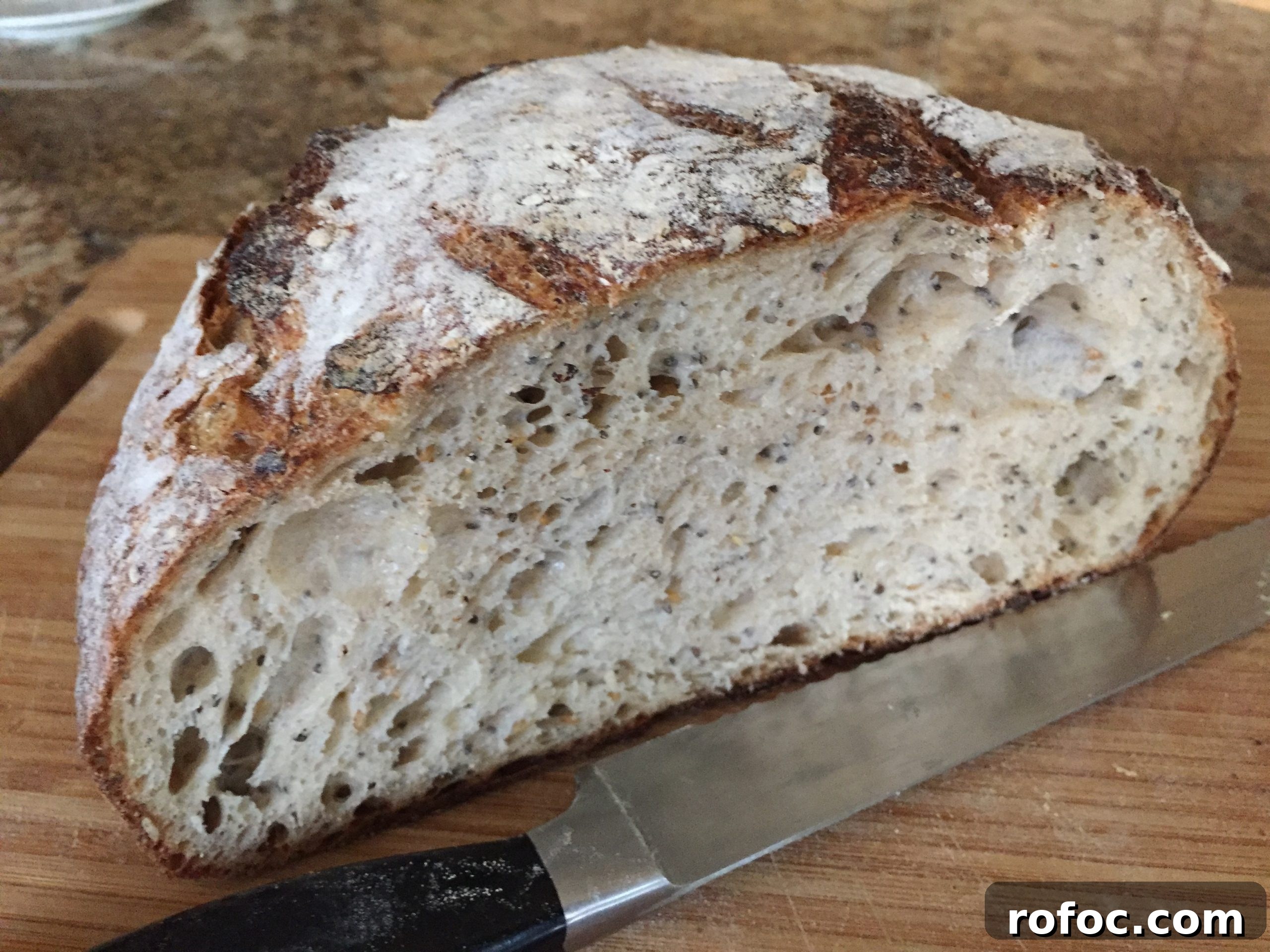
For this chia and flax seed sourdough, I added chia and flax to a basic sourdough formula to give it more moisture, texture and nutrition. Both seeds are highly nutritious: one tablespoon of ground flax provides protein, fiber and omega-3s along with small amounts of vitamins and minerals. Chia seeds also contribute hydration and a pleasant crunch when toasted.
I adjusted the water in this recipe to account for chia’s hydrophilic nature so the final loaf is moister. When toasted, chia adds crunch while flax brings a nutty flavor. The instructions below include timers and step checkboxes to make the process easier—enjoy the baking and share how it turns out!
CHIA AND FLAX SEED SOURDOUGH BREAD
Equipment
- Cast iron dutch oven
- Banneton set for sourdough proofing
- 2 large bowls
- Bread lame, razor or scissors
- Dough scraper and cutter
- Digital scale
- Dish towel to cover dough
Ingredients
- 330 grams water (about 80°F / lukewarm)
- 100 grams levain (active sourdough starter)
- 400 grams bread flour
- 100 grams whole wheat flour
- 9 grams salt
- 25 grams boiling water (for salt solution)
- 20 grams chia seeds
- 20 grams flax seeds
- 80 grams water (to soak chia seeds)
- Rice / bread flour mixture for dusting banneton
Instructions
Prepare ingredients the night before
- Make your levain the night before so it is active and bubbly for mixing.
- Soak the chia and flax seeds with boiling water and stir; set aside to hydrate.
- Dissolve the salt in the boiling water designated for the salt solution. It’s okay if not all salt dissolves.
Making the dough
- Sift the bread and whole wheat flours into a bowl to remove any lumps.
- In a separate bowl, mix the levain into the lukewarm water until combined (it does not need to fully dissolve).
- Add the flour mixture to the levain-water and mix to form a shaggy dough. This autolyze helps the flour absorb liquid and improves handling.
- Let the dough rest for 30 minutes to autolyze (set a 30-minute timer).
- Mix the salt solution into the hydrated chia/flax mixture so it becomes very thick—stiff enough that a teaspoon can stand erect in the center.
Kneading and bulk fermentation
- The dough is now ready for bulk fermentation. At 70–80°F, bulk fermentation typically takes around 3 hours.
- Add the salt and chia/flax mixture to the autolyzed dough and incorporate thoroughly.
- With wet hands, perform stretch-and-folds: pull the top of the dough, fold it over, rotate a quarter turn and repeat. Aim for 4 full revolutions (about 16 pulls).
- Let the dough rest for 30 minutes (set a 30-minute timer).
- Knead briefly, then repeat alternating rests and kneads as the recipe directs—working through several 30-minute rest cycles until the dough becomes soft, pliable and well-developed. If the dough is not yet supple, continue bulk fermentation for another 30–60 minutes.
Shaping
- Turn the dough out, weigh and divide if making smaller loaves. This recipe is for one large loaf; for two smaller boules, divide and bake in a 2-quart dutch oven.
- On a floured surface, shape the dough into a taut round by pulling the dough toward you and rotating. The goal is to tighten the surface and expel large gas pockets.
- Let the shaped dough rest for 10 minutes (set a 10-minute timer), then shape again to refine the surface tension.
- Prepare your banneton or bowl by generously dusting with the rice/bread flour mixture. Place the shaped loaf in the banneton seam-side up to proof.
Proofing
- Cover the banneton with a damp cloth and proof in a warm place for about 2½ hours (150 minutes). If you need to delay baking, refrigerate for a slow proof and bring it back to room temperature for about an hour before baking.
- When proofing is nearly complete, preheat the oven with the cast iron dutch oven inside. Preheating usually takes about 30 minutes.
Scoring and baking
- Transfer the loaf to parchment if using, or invert the banneton directly into the preheated dutch oven using parchment paper. Handle the proofed dough gently so it retains structure.
- Dust the top with flour and score with a lame, razor or sharp scissors to control expansion and create a decorative pattern. Cover with the pot lid.
- Reduce oven temperature to 450°F. Bake covered for 25 minutes for one large loaf (20 minutes for smaller 2-quart boules).
- Remove the lid and continue baking uncovered for an additional 25 minutes for a large loaf (20 minutes for smaller boules) until the crust is deep golden and the internal temperature reaches a typical finished range for sourdough.
- Remove the loaf from the oven and the dutch oven, and cool on a wire rack before slicing.
- If baking a second loaf: return the dutch oven to 500°F for 10 minutes, wipe it dry, then repeat the baking steps for the second loaf.
Notes
Makes one loaf in a 3.3 qt (24 cm) cast iron dutch oven. The recipe includes timers for convenience; note that timers provided by some apps may stop if the device sleeps or the page is closed.
Nutrition
Serving size: 1 slice — Calories: 68 kcal