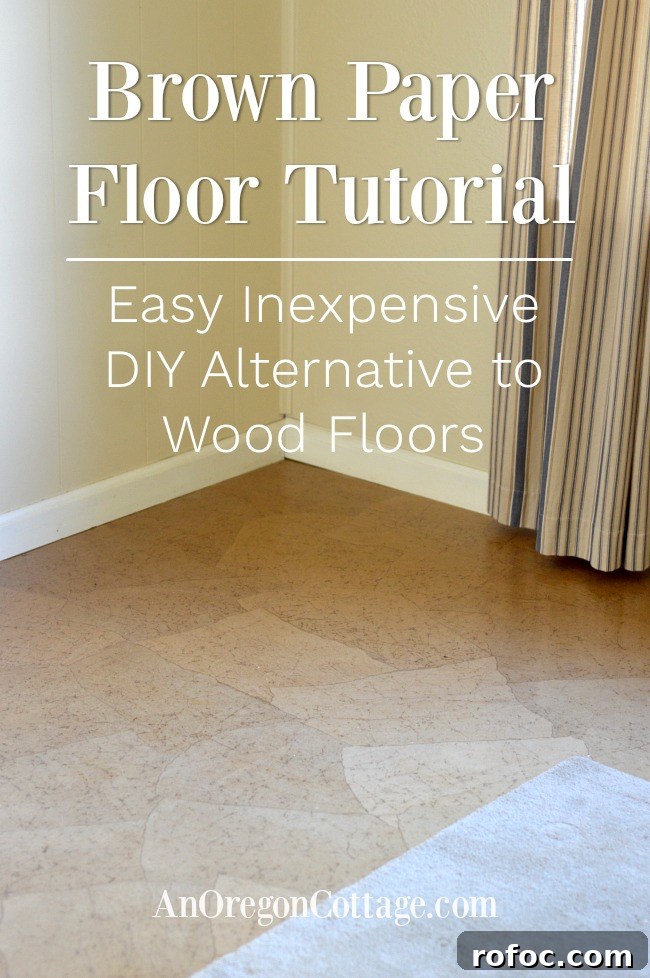
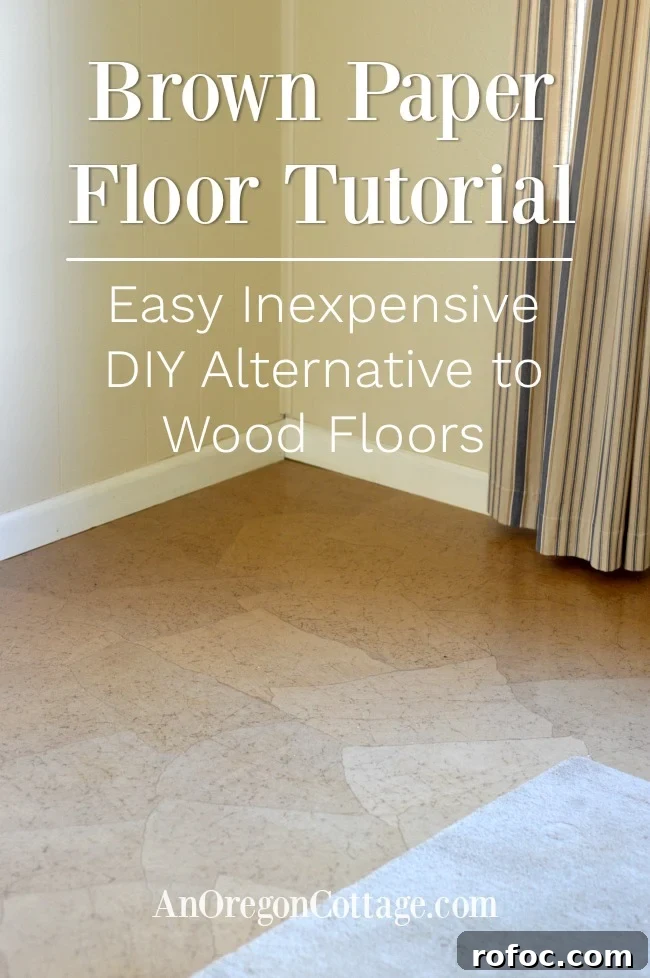
Welcome to one of our most popular DIY projects at AOC. This brown kraft paper floor technique has been pinned and viewed on YouTube more than a million times and was even featured in an issue of Cottages and Bungalows. It’s an accessible DIY anyone can attempt and produces a leather-like floor that holds up surprisingly well.
Below you’ll find an overview of the technique, our step-by-step video tutorial showing how to create this floor using brown kraft paper and glue, and a concise supplies list.
Some links in this article are affiliate links; if you click them and make a purchase I will receive a small commission at no additional cost to you.
UPDATE: See the definitive FAQ for the Paper Floor Technique where we answer many common questions about this brown paper floor solution to worn or nasty carpet.
UPDATE #2: Watch our follow-up video: Brown Paper Floor — How Do They Look 4 Years Later?
So what is a paper floor and is it really doable? Yes — it’s essentially a decoupage flooring technique I first tried in our 1940 Portland bungalow. We used it on stairs and upstairs rooms, thinking it might be temporary, but it surprised us with its durability and appearance. We had no trouble selling the house five years later and the new owners loved the floors.
When we moved to our 1980s ranch, we used the paper floor again to replace old carpet in our children’s rooms. It’s an excellent, low-cost alternative to expensive hardwood, delivering a warm, leather-like look with the clean, décor-friendly feel of wood and easy maintenance.
Why ditch carpet?
We prefer wood-look floors and have strong reservations about wall-to-wall carpet. Carpet can be:
- expensive to replace,
- difficult and costly to install as a DIY project,
- hard to keep clean around pets and kids,
- subject to persistent odors and embedded soils that professionals warn may be impossible to fully remove,
- prone to dusty, dirty edges even with regular vacuuming,
- fixed in color with little flexibility,
- problematic for some allergy sufferers,
- and, in rural homes, it quickly shows mud and outdoor grime tracked in on shoes.
If you’re looking to remove carpet but can’t afford real wood flooring, or you simply don’t like carpet, this torn-paper decoupage method is a great option. We’ve been replacing carpeting throughout our ranch-turned-cottage and kept the paper floor for kid-friendly rooms with great results.
Paper floor — really?
Yes. The process is straightforward, affordable and surprisingly attractive. The torn kraft paper layered and sealed with water-based polyurethane creates a textured, leather-like surface with minimal effort.
Does it last?
When sealed with a water-based polyurethane the paper floor wears very well in low- to moderate-traffic rooms. For heavy-traffic areas, traditional hardwood or commercial-grade flooring is still recommended.
How much does it cost?
This method is extremely economical. For example, a 12′ x 11′ room cost us around $65 total — roughly $0.50 per square foot — which is an excellent price for new, attractive flooring.
Brown Paper Floor
Here’s how it looks in our daughter’s room:
I love seeing this view from the hallway instead of the old stained carpet. The room feels airier and visually larger now.
With this base floor we can add whatever area rug or carpet we like, and if it gets stained later it’s inexpensive to replace. The torn kraft paper pieces we used all came from the same roll but dried in slightly different tones, creating depth and interest rather than a flat, uniform color.
You can view more of the finished floor in our follow-up video showing the results four years later.
Brown Paper Floor Tutorial Video
If you want to replicate this floor, watch our tutorial video that demonstrates every step and the tools you’ll need. A supplies list follows the video:
Brown Paper Floor Supplies
Floor Preparation
- Wood filler for gaps or holes in the subfloor.
- Sanding paper for smoothing rough areas and edges.
Applying the Paper
Brown builder’s paper in a large roll — a 140-foot roll covered our 12×11′ and 11×11′ rooms:
- Large roll of brown builder’s paper (available at hardware stores).
- One gallon of PVA or multi-purpose glue — one gallon covers about an 11×11′ or 12×11′ room.
Other tools:
- Small bucket and stir stick,
- 3-inch paint brush,
- scissors,
- trash can,
- container for water.
Optional Staining
If you want a darker or more varied tone you can apply a water-based stain after the glue has dried and before polyurethane. Water-based stains are recommended to remain compatible with the rest of the finish.
Typical application tools:
- 9-inch pad applicator for the main area,
- Disposable chip brushes or 2-inch foam brushes for edges,
- Disposable gloves.
Polyurethane Coating
Use a floor-grade water-based polyurethane. One gallon will provide multiple coats for a 10×10′ to 10×12′ room. Options include water-based polycrylic or floor-grade water-based polyurethane in satin finish.
Application methods:
- 4-inch brush attached to a long pole for brushing,
- Pad applicator on a pole for smoother coverage,
- Foam 9-inch roller on an extension pole to minimize shedding and bubbles.
Paper Floor Testimonials
Kee Kee 1/2019
Thank you so much for sharing this flooring method. I love the look, low maintenance, durability, and cleanliness. When we removed laminate, the subfloor was full of mildew and grime. The seamless paper floor means I never have to worry about that. Thank you.
Dee 5/2019
I used this technique about 13 years ago in a bathroom and it’s still holding up without needing a recoat. I added stain to my glue mix and applied it over vinyl with no problems. I used crinkled small paper pieces and heavy coats of poly — it looks amazing even in a heavy-traffic laundry area.
Please let us know if you try this technique — we’d love to hear and see how it turned out for you!
This tutorial has been updated; it was originally published in August 2010.
Disclosure: affiliate links in this article may earn a commission based on sales at no extra cost to you.